Author: Aaron Lietz

Aaron Lietz is the Founder and President of the Light of Reason Foundation, a nonprofit educational institution promoting scientific education, scientific skepticism, sound reasoning, secular humanism, and the separation of church and state. Aaron holds a BA in Philosophy from the University Illinois.

Problem of a New Planet

Some years ago, after leaving religion and beginning to deconstruct my libertarian phase, I found myself debating so-called “anarcho-capitalists,” many of whom were simply parroting figures like Ayn Rand, Stefan Molyneux, and the usual internet propertarian talking points. During that period, a thought experiment occurred to me that forced me to think more carefully about the structure of the U.S. economy, property rights, taxation, coercion, and the moral assumptions buried inside political language. I present it here as a challenge to the idea of “freedom” that these types constantly invoke but rarely define with any seriousness, breadth, or depth.

Imagine that humanity finds itself in the middle of another world war. Conditions on Earth have become so catastrophic that ten scientists and astronauts board a futuristic spacecraft and leave the planet in search of somewhere else to live. After a long journey, they discover an exoplanet remarkably similar to Earth: breathable air, drinkable water, fertile soil, forests, minerals, rivers, and enough resources for all ten of them to survive.

The ship lands. The doors open. Everyone looks out at this strange new world with awe and relief. But before the group can discuss how they should proceed, one astronaut — the libertarian of the group — leaps down from the platform and plants his boots in the dirt. He turns back to the others and announces:

“Ha! I touched the ground first. Therefore, this planet is now mine. I am the rightful owner of this land, its water, its resources, and everything connected to it. If the rest of you want to live here, farm here, build here, drink from the rivers, or use any of the materials, you will have to pay me rent. And if you resist, you are violating my property rights and aggressing against me. I will defend myself accordingly.”

The absurdity here should be pretty obvious. Nothing about being first to touch the ground gives him a moral right to dominate everyone else’s conditions of survival. He did not create the planet. He did not create the rivers, the soil, the atmosphere, the forests, or the minerals. He did not even arrive there by himself. The journey was collective. The discovery was collective. The survival problem is collective. Yet through one arbitrary declaration, backed by the threat of violence, he attempts to convert a shared world into his private kingdom.

At this point, the libertarian may object: “But what if he had left Earth on his own? What if he built the ship himself, found the planet himself, and arrived there entirely by himself? Then wouldn’t the planet be his?”

But this objection still does not solve the problem. Even if he found the planet alone, why should discovery by itself generate total ownership? Why should “I got here first” mean “everyone else must now obey me”? Why should first contact with land, water, air, forests, and minerals create a moral right to exclude every future person from the basic materials of life?

That is not an argument. That is a mere assertion of “first past the post” dressed up as moral philosophy. It treats property as though it can be created by personal fiat: “I saw it first, therefore it is mine.” But no serious account of property can rest on that alone. A claim of ownership is not self-justifying simply because someone announces it loudly enough or defends it violently enough.

Property rights are not magical facts floating in the air. They are social and moral arrangements. They require justification. They require norms. They require recognition. They require some kind of mutual agreement about who may use what, under what conditions, and for what reasons. Without that, “property rights” reduce to nothing more than power: whoever can grab something, fence it off, and threaten others most effectively becomes the “owner.”

And that is not liberty. That is feudalism with a marketing department.

Of course, another objection often follows: “But if property is based on mutual agreement, then couldn’t a group of people simply come together and mutually agree to take someone else’ property away?”

This objection misunderstands the point. Saying that property rights are socially established does not mean they are infinitely or easily disposable, simpliciter. It does not mean that whatever the majority wants at any given moment automatically becomes just. A civilized society can recognize that property rights are created and maintained through social agreement while also building fundamental laws that protect individuals from arbitrary seizure, mob rule, corruption, and abuse.

That is precisely why societies develop constitutions, courts, legal procedures, due process, public standards, and limits on both private and state power. The point is not that property belongs to whoever can gather the biggest crowd. The point is that property claims must be justified within a legal and moral order and framework, not simply asserted by force, inheritance, conquest, or luck.

The alternative is not freedom. The alternative is vigilante rule. It is private armies, feudal lords, corporate kingdoms, warlords, and “justice” carried out by whoever merely has the most weapons, money, or leverage. We have already seen versions of this throughout human history, and it has not gone well. 

This is the problem that so much right-wing libertarian and anarcho-capitalist rhetoric tries to hide. It speaks endlessly of “freedom,” “rights,” “non-aggression,” and “voluntary exchange,” but it often smuggles in a prior assumption: that existing property claims are already legitimate. Once that assumption is granted, taxation becomes theft, regulation becomes coercion, and the person born propertyless into a world already owned by others is described as “free” because no one is directly holding a gun to his head.

But this is a shallow concept of freedom. If every field, river, building, tool, machine, road, and workplace is already owned by someone else, then the propertyless person is not meaningfully free in any serious sense. He is free only in the narrowest and most ideological sense: free to obey the terms set by owners, free to sell his labor to survive, free to be excluded from the resources required for life, and free to call this arrangement “voluntary.”

So the question is not merely, “Did someone interfere with your property?” The deeper question is: how did that property claim become legitimate in the first place? Who decided that one person, or one class of people, gets to control the basic conditions of life while everyone else must pay for access? And why should we treat that arrangement as freedom rather than as domination wearing the language of liberty?

The New Planet example exposes a gaping hole in the so-called libertarian notion of freedom and property rights. If the Anarcho-Astronaut does not legitimately own the planet merely because his boot touched the dirt first, then the same problem applies to human history more broadly. No particular human being, tribe, family, king, corporation, or class of people had some obvious, pre-social, absolute ownership claim over the land and resources of the Earth from the dawn of humanity onward.

Imagine, for example, an early group of human beings trying to survive in North Africa hundreds of thousands of years ago. One member of the group begins working a particular patch of soil more than the others. Perhaps he gathers food there, clears brush, builds a shelter, or tends the area in some useful way. Does that labor give him some practical claim to continue using what he has worked on? Maybe. But does it give him absolute ownership over the land itself? Does it give him the right to exclude everyone else from the water, plants, animals, minerals, and surrounding territory necessary for survival? Does it give him the authority to tell the rest of the group, “This is mine now, and you must pay me or obey me if you want access”?

At most, his labor may create a claim that others should respect his effort, his shelter, his tools, or the immediate fruits of his work. But that is very different from saying he has transformed part of the natural world into his private kingdom. The leap from “I used this” to “I own this absolutely” is precisely the leap that needs to be justified. It cannot be smuggled in through slogans about liberty, self-ownership, homesteading, or non-aggression. So too, so called Libertarians need to realize that such an arbitrary move can just as easily be used in the opposite direction.

Ownership, Liberty, & Freedom 

Within these debates there are some other more foundational issues that begs our attention. Historically, “libertarian” did not originally mean what many American right-wing libertarians now mean by it. It was tied to anti-authoritarian, anarchist, and socialist traditions that opposed domination by both the state and capital. That matters because the modern propertarian use of “liberty” often protects only one kind of freedom: the unabated ability of owners to command, exclude, extract, accumulate, while calling their power “rights.”

But “freedom” does not simply mean that property owners are left alone to do whatever they want with whatever they happen to control. That is not a neutral definition of freedom. It is a definition loaded in favor of those who claim ownership. It treats interference with ownership as the central form of coercion while ignoring the coercive power that ownership itself can create.

If one person owns all the land, another owns the water, another owns the housing, another owns the roads, another owns the workplace, and another owns the tools needed to produce and survive, then the person who owns none of these things is not meaningfully “free” merely because no government official is pointing a gun at him. His life is still structured by commands, exclusions, permissions, prices, contracts, and threats. He must ask permission to live somewhere, work somewhere, grow food somewhere, use tools somewhere, or access the resources necessary for his continued existence.

This is why the rhetoric of “voluntary exchange” is often so misleading. A contract is not automatically free simply because it is formally agreed to. Background conditions matter. If the alternative to accepting someone’s terms is homelessness, hunger, poverty, exclusion, or death, then the agreement may be voluntary only in the thinnest and most ideological sense. The question is not merely whether someone signed the contract. The question is what social arrangement forced that contract to become the only survivable option in the first place.

Right-wing libertarianism often wants to begin the moral conversation after the world has already been divided up. It starts after the land has been claimed, the deeds have been written, the fences have been built, the factories have been inherited, the mines have been privatized, the police or private security forces have been positioned, and the propertyless have been told they are “free” to negotiate. This is kind of like a child being born into a private prison system and then being told, “You are free to do what the prison allows you to do.” What a garbage definition of freedom. The real philosophical question comes before all of that: who had the right to divide the world this way in the first place?

And herein lies the central problem. If a property claim is legitimate, then it must be more than a historical accident. It must be more than first possession (i.e. – first past the post). It must be more than conquest. It must be more than inheritance. It must be more than “my ancestor got there first,” “my company purchased it,” “the state recognized it,” or “I can afford to defend it.” Those may explain how a property claim came to exist, but they do not by themselves show that the claim is morally justified.

Any serious theory of freedom must account for more than the ability of happenstance of owners. It must also account for the freedom of those born into a world already owned by others. It must ask whether people have genuine access to the conditions necessary for human life and flourishing. It must ask whether people are subject to arbitrary domination, whether from the state, corporations, landlords, employers, inherited wealth, private security forces, or any other power capable of controlling their lives.

This does not mean that no property rights should exist. It does not mean that individuals should have no homes, possessions, tools, businesses, farms, savings, or personal claims. The point is not to erase every distinction between mine and yours. The point is that property rights are not self-justifying. They must be situated within a broader moral and social framework that recognizes the equal standing of persons and prevents ownership from becoming a weapon of domination.

A society in which a few people control the basic conditions under which everyone else must live is not a free society simply because those few people are called “private owners” rather than kings. If the result is that most people must submit to owners in order to survive, then the language of liberty has become a mask for hierarchy.

This is why the New Planet example matters. It strips away the inherited assumptions and forces us to look at the issue at the beginning. Before the deeds, before the courts, before the police, before the banks, before the landlords, before the corporations, before the accumulated wealth, before all the ideological fog, there is a simple question: why should one person’s claim over the world bind everyone else?

Until that question is answered, the libertarian appeal to property rights remains incomplete. And if the answer is merely “because I got there first,” or “because I mixed my labor with it,” or “because I say so,” or “because I am rational,” or “because I will defend it,” then we are not dealing with a serious theory of liberty. We are dealing with domination that has learned to speak in the language of freedom.

Objections (Oncoming Traffic)

There are, of course, other objections the anarcho-capitalist may raise.

  •  “My property rights are grounded in self-ownership. I own myself; therefore I own my labor; therefore I own whatever I mix my labor with.”

But this does not get them nearly as far as they think it does. Even if we grant self-ownership for the sake of argument, it does not follow that a person can come to own an entire planet, river, forest, field, or mineral system merely by interacting with it. My body may be mine. My labor may be mine. But the external world is not my body. If I pick an apple, build a shelter, dig a well, or cultivate a garden, perhaps I have some claim to the product of that labor. But that is very different from saying I now own the entire ecosystem around it, or that every future person must pay me tribute to exist there.

The labor-mixing argument also has a strange magical quality to it. If I pour a can of minerals and fish food into the ocean, I do not thereby come to own the ocean. If I carve my initials into a tree, I do not thereby own the forest. If I walk across a continent, I do not thereby own the continent. Labor may generate some kind of claim, especially to improvements one has actually made, but it does not automatically generate absolute dominion over natural resources that one did not create.

  • “But there are natural rights. Property rights exist prior to society. They do not need anyone’s agreement.”

But again, this is just an assertion masquerading as an argument. To say “I have a natural right to this property” is not enough. The question is: why should anyone else accept that claim? A moral claim is not made valid simply because someone announces it with confidence. If the libertarian says, “I have this right because I am a rational being,” the obvious response is: so is everyone else. Rational agency may ground equal moral consideration, but it does not obviously ground one person’s unilateral authority to control the material conditions of everyone else’s life.

In fact, if rationality grounds rights, it seems to point in the opposite direction. It suggests that all rational beings deserve justification, not domination. It suggests that no one may simply announce, “This world is mine, and you must pay me to live on it.” A right that exists only because one person asserts it is not a right. It is a preference backed by force.

  • The anarcho-capitalist may then say, “But I am not merely asserting it. Homesteading establishes ownership. The first person to appropriate unowned land becomes its owner.”

But this just kicks the question back one step. Why should homesteading have that moral power? Why should first possession create permanent exclusion? Why should arriving first give one person authority over those who arrive later? The homesteading principle is not self-evident. It is a proposed rule. And like any proposed rule, it requires justification.

If ten people arrive on a new planet together, and one person says, “The rule is that whoever touches something first owns it forever,” the other nine are perfectly reasonable in asking, “Why should we accept that rule?” The rule is obviously convenient for the person who got there first, but that does not make it morally legitimate.

  • “But without absolute private property, everything becomes chaos. People will just steal from each other.”

This is a false choice. The options are not absolute private property on one hand and total chaos on the other. A society can recognize personal property, homes, tools, possessions, businesses, farms, and legitimate claims of use without pretending that one person can morally own the basic conditions of life by mere declaration. The question is not whether any property should exist. The question is what kind of property, under what justification, with what limits, and for whose benefit.

There is a meaningful difference between owning your shoes, your guitar, your house, or the crops you grew, and owning the only river, the only fertile valley, the only mine, or the only habitable land. A serious theory of property has to recognize this difference. Anarcho-capitalism often erases it by treating all property claims as though they were morally equivalent.

  • “If people do not like the property owner’s terms, they can leave.”

But this response only works when there is somewhere else to go. If all usable land and resources are already claimed, then “you can leave” becomes hollow. Leave to where? Another property owner’s domain? Another landlord’s terms? Another workplace controlled by someone else? The mere fact that a person can move from one privately controlled space to another does not prove that he is free in any robust sense of the term.

A person trapped in a room with ten doors is not free if every door leads to a different master.

  • The anarcho-capitalist may also appeal to voluntary exchange: “No one is forcing anyone. If someone pays rent, accepts a job, or buys access to resources, that is voluntary.”

But “voluntary” becomes a very thin concept when the alternative is deprivation. If one person controls the water and everyone else must pay him or die of thirst, the transaction may be formally voluntary in the narrow sense that no one physically moved their hand for them. But morally, the situation is coercive. The background conditions matter. A choice made under artificial exclusion from the necessities of life is not meaningfully free merely because it takes the form of a contract.

This is where anarcho-capitalism often plays a shell game. It condemns state coercion while ignoring private coercion. It sees taxation as force, but it does not see rent, wage dependence, resource monopoly, inherited ownership, enclosure, or exclusion as force. But exclusion is force. The fence is force. The lock is force. The armed guard is force. The threat of being removed from the means of survival is force. Calling it “property rights” does not make the coercion disappear.

  • “But private defense agencies could protect property rights without a state.”

But then the question becomes: whose property rights, according to which rules, enforced by whom, and accountable to whom? If multiple armed agencies disagree about ownership, contract, punishment, or restitution, then either one becomes dominant, in which case it begins to resemble a state, or they compete violently, in which case we have privatized warfare. The problem has not been solved. It has simply been outsourced to whoever can pay for the strongest private army.

This is why anarcho-capitalism so easily collapses into neo-feudalism. In theory, everyone is a sovereign individual. In practice, those with the most wealth purchase the most protection, the most land, the most influence, and the most effective violence. Everyone else becomes dependent on private powers that are not democratically accountable.

  • Another objection may be more bluntly metaethical: “There is no deeper justification needed. Rights just are what they are. I have the right to property because I say I do, because I am rational, because I own myself, or because aggression is wrong.”

But this is precisely the problem. A moral claim that imposes duties on others requires public justification. If I say, “You are morally required to stay off this land, pay me rent, obey my rules, and recognize my authority,” I owe you an explanation. Merely say, “Because I have right.” is question-begging. The question is why (and how) this alleged right exists, why it has this scope, and why it should bind everyone else.

Non-“Aggression” and the “Initiation” of Force

Yet another predictable response from the anarcho-capitalist is an appeal to the Non-Aggression Principle, or “NAP”:

  • “But see, I go by the NAP. If you initiate aggression against me, I have the right to defend myself against that aggression by the use of force.”

But this immediately raises the question: what counts as “aggression”? What does that word actually mean?

Anarcho-capitalists and right-wing libertarians often play fast and loose with this term. On the surface, the NAP sounds obvious and reasonable: do not initiate force against peaceful people. Fine. Most people can agree with that in some general sense. But the difficulty appears the moment we ask what counts as “force,” what counts as “peaceful,” and what counts as “aggression.”

Is taxation aggression? Is eviction aggression? Is enclosing the only freshwater source aggression? Is threatening starving people with violence if they take food from unused land aggression? Is crossing a fence aggression? Is building the fence aggression? Is resisting exclusion aggression? Is the original act of exclusion aggression?

The NAP does not answer these questions by itself. It depends entirely on a prior theory of property, ownership, rights, and legitimacy. If that prior theory is unjustified, then the NAP merely protects whatever unjust distribution already exists.

Suppose the Anarcho-Astronaut declares the new planet his private property. The others reject his claim and begin drinking from a nearby river. He says, “You are aggressing against me by trespassing on my land and stealing my water.”

But the others can reasonably respond, “You have not shown that this is your land or your water in the first place.”

That is the problem. The NAP cannot tell us whether their action is aggression until we already know whether his property claim is legitimate. If the planet really is his, then perhaps their use of the river counts as trespass. But if the planet is not his, then his attempt to exclude them from the river may itself be the act of aggression.

So the NAP does not solve the dispute. It presupposes a solution to the dispute.

This is why the principle is far less useful than anarcho-capitalists pretend. It sounds like a neutral rule against violence, but in practice it smuggles in an entire theory of property. It says, “Do not aggress against people or their property,” while leaving unanswered the most important question: what makes something legitimately their property?

So when the libertarian says, “You are aggressing against me by using my land,” the correct response is: “You have not yet shown that it is rightfully yours, or how that alleged right was established in the first place.”

That is the central issue. Anarcho-capitalism tries to begin the moral conversation after property has already been assigned. It wants to start the game after the board has been divided, the deeds have been written, the fences have been built, the security guards have been hired, and the propertyless have been told they are free to choose among owners. But the real philosophical question comes before all of that: how were these claims justified in the first place?

If ownership has not been justified, then “defense of property” may simply be aggression in disguise. A man who fences off the only freshwater source and threatens to shoot anyone who drinks from it may call his violence “self-defense,” but that does not make it so. If his claim to the water is illegitimate, then his exclusion of others is not defense. It is domination.

This is where the libertarian use of “aggression” becomes selective. Taxation is aggression. Regulation is aggression. Redistribution is aggression. But enclosure is not aggression. Eviction is not aggression. Charging rent for access to land one did not create is not aggression. Threatening desperate people who attempt to use unused resources is not aggression. Private security removing the poor from spaces necessary for survival is not aggression. Somehow, the word “aggression” is almost always aimed at challenges to property, but rarely at the property system itself.

But why accept that framing?

If a person claims the Earth, or part of the Earth, or the only usable resources in a region, and then uses force to exclude everyone else, why is that not aggression? Why is the first act of exclusion treated as peaceful, while resistance to that exclusion is treated as violence? Why does the fence count as neutral, but the starving person crossing the fence counts as aggression? Why does the deed count as peaceful, but the dispossessed person questioning the deed counts as a threat?

The answer is that the NAP depends entirely on the legitimacy of the background property arrangement. If the property arrangement is just, then force used to defend it may be defensive. But if the property arrangement is unjust, arbitrary, coercive, or historically rooted in conquest and exclusion, then force used to preserve it may be the very thing the NAP claims to oppose.

This means the anarcho-capitalist cannot simply say, “I have a right to defend my property.” The prior question is: why is it your property? Until that question is answered, the appeal to self-defense is premature.

Consider again the New Planet example. If the Anarcho-Astronaut points a weapon at the others and says, “Leave my land or I will defend myself,” he has not avoided aggression. He has merely renamed his aggression as defense. He is not defending a legitimate moral order. He is attempting to create an order by force and then demanding that everyone else treat his violence as morally sacred.

This is the shell game. First, he asserts ownership. Second, he defines any violation of that asserted ownership as aggression. Third, he claims a right to use force against that aggression. But the entire argument depends on the first step, and the first step has not been justified.

So the response to the NAP objection is simple:

You cannot define aggression by appeal to property rights until you have already justified the property rights.

Otherwise, the NAP becomes circular. It says, “It is wrong to violate my property because violating my property is aggression, and it is aggression because it violates my property.” That is not a moral theory. That is a loop.

If property rights are legitimate, they must be more than declarations. They must be more than “I got here first.” They must be more than “I mixed my labor with it.” They must be more than “I am rational, therefore this is mine.” They must be embedded in a moral and legal order that recognizes the equal standing of persons, protects individuals from arbitrary seizure, and prevents the basic conditions of life from being converted into instruments of domination.

Otherwise, “liberty” becomes little more than the freedom of the first claimant, the strongest enforcer, or the richest owner to rule everyone else.

A serious theory of liberty must do more than condemn aggression after ownership has already been assigned. It must ask whether the original assignment of ownership was legitimate, whether the resulting system subjects people to domination, and whether the so-called “defense” of property is actually defending freedom or merely protecting hierarchy.

A Useless Term

Another problem concerns the phrase “the initiation of force.” Anarcho-capitalists often use this phrase as though its meaning were obvious, when it is not obvious at all. In fact, unless carefully defined, the phrase is either morally impotent or nearly meaningless.

What does it mean to “initiate force”? If it simply means to be the first cause of some physical pressure, movement, harm, or interference, then countless things “initiate force” all the time. A hurricane initiates force. A disease initiates force. A falling rock initiates force. A bear breaking into a chicken coop initiates force. Parents deciding to bring a child into existence initiates a causal chain that the child never consented to. The initial expansion of the known universe itself initiated force, energy, matter, motion, and conditions no anarcho-capitalist consented to.

But surely this is not what the anarcho-capitalist means. They do not usually think a hurricane violates the NAP. They do not think gravity commits aggression. They do not think the Big Bang morally aggressed against them. So “initiation of force” cannot merely mean “the first physical cause of some unwanted effect.” If that is all it means, the phrase becomes too broad to be useful.

The anarcho-capitalist might respond, “No, the initiation of force only counts when it is done by rational agents.”

But now we have moved from a physical claim to a normative claim (i.e. – we have moved from the topic of physics to the topic of normative ethics, and other related fields, in philosophy). The issue is no longer merely force. The issue is agency, responsibility, intention, moral standing, rights, duties, and blame. At that point, the Ancap needs to provide an argument. Why should the concept be limited in precisely that way? What counts as a rational agent? Does moral responsibility require libertarian free will? Does it require the ability to have done otherwise? Does it require responsiveness to reasons? Does it require conscious intent? And why should this theory of agency be accepted by everyone else?

The ANCAP cannot simply define the problem away. If the NAP depends on a distinction between morally responsible agents and non-responsible natural causes, then the NAP depends on a prior theory of moral responsibility. That theory needs to be defended. It cannot just be asserted or assumed.

Consider an example. Suppose the anarcho-capitalist legitimately owns a rural property in Alaska. One day, a large Kodiak bear wanders across the property line, breaks into his chicken coop, eats several chickens, and then starts eating fruit from his trees. In a plain causal sense, the bear has initiated force. It has crossed a boundary, damaged property, consumed resources, and interfered with the owner’s plans.

But has the bear committed aggression in the moral sense?

If the anarcho-capitalist says yes, then the term “aggression” has become incoherent. Is the bear a rights-violator? Is the bear morally culpable? Did the bear consent to the property system? Does the bear recognize land titles? Does the bear understand the non-aggression principle? Does the bear have libertarian free will? Does the bear possess the kind of agency required to be held morally responsible?

Surely not.

Of course, the property owner may still have practical reasons to use force against the bear. He may defend his chickens, protect his home, scare the bear away, or, in extreme cases, kill the bear to protect himself or others. But that is not because the bear has morally aggressed against him in the same way a person might. It is because the bear poses a threat. The situation is one of danger management, not moral blame (similar to protecting against an avalanche that is rolling down a hill toward your home).

This distinction matters because it shows that “force” and “aggression” are not the same thing. Force is a physical concept. Aggression is a moral concept. To call something aggression is not merely to say that force occurred. It is to say that force occurred wrongfully, by an agent who was morally bound not to do it.

But once we admit that, the NAP is no longer a simple axiom. It is the conclusion of a much larger moral theory. Before the anarcho-capitalist can say, “You initiated aggression,” they must first explain what aggression is, what rights exist, what they are, who has them, what counts as violating them, what kind of agency is required, and why their property theory is legitimate in the first place.

This creates a serious problem for the slogan. Again, if “initiation of force” is defined broadly in causal terms, then bears, avalanches, storms, diseases, births, and cosmic events all initiate force, making the concept morally useless. But if “initiation of force” is defined narrowly in moral terms, then the anarcho-capitalist must defend a whole set of controversial assumptions about moral agency, responsibility, freedom, and rights (which will likely be a very difficult hill for him/her to climb).

Either way, the phrase does not do the work they want it to do.

This becomes especially important when we return to property. Suppose a starving person crosses a fence to drink from a stream that a landholder claims as private property. The Ancap says, “That person initiated force by trespassing!” But why is crossing the fence the first relevant act of force? Why not the fence itself? Why not the original exclusion from the water? Why not the threat of violence used to keep others away from a resource necessary for life?

Under this usage, the phrase “initiation of force” pretends to identify the morally first act, but it often just identifies the first act that disrupts an already-assumed property arrangement. It begins the story exactly where the property holder wants the story to begin, when in fact that is the very thing under question.

That is why the concept is so slippery. The anarcho-capitalist says, “I oppose the initiation of force,” but what they often mean is, “I oppose force that interferes with the property claims I already recognize as legitimate.” But the legitimacy of those property claims is the very thing under dispute.

So again, the NAP begins too late. It starts after ownership has already been assigned, after the fences have already been built, after the land has already been claimed, and after the propertyless have already been told what counts as aggression. But if those background claims have not been justified, then the accusation of “initiating force” is premature.

The proper response is: you have not yet shown that this is aggression, because you have neither defined the term aggression in the morally salient sense nor have you shown that said property is actually yours.

Aaron Lietz
Why I Launched Light of Reason

For about fifteen years, I was a committed fundamentalist evangelical Christian. I went on mission trips, canvassed door to door, preached Jesus on street corners, volunteered 5 nights a week at multiple churches, taught classes on apologetics, donated lots of money to multiple churches, fed the homeless, led people in prayer, and debated with non-Christians (both online and in person). For all intents and purposes my “fruits” were good, very good. I wasn’t casually religious. I was serious. Passionate. Extremely devoted. Certain.

And I was wrong.

Not wrong about everything. Not insincere. Not malicious.

But wrong in the most important way: I was mistaken.

The Cracks Begin to Show

Over time, I was challenged by a wide range of people — former Christians, people from other denominations or religious traditions, college professors, authors, online writers, and thoughtful skeptics. These weren’t the caricatures I had been warned about. They were intelligent, patient, and often far more informed than I was.

The more I engaged with them, the more uncomfortable I became.

I began to realize that I was guilty of the very thing I accused others of: irrational thinking.

That realization wasn’t immediate, and it wasn’t easy. It was the beginning of a long and often painful process of intellectual deconstruction.

Improved Thinking Skills

During this time period, I immersed myself in education.

I took college courses in logic. I studied critical thinking in depth. I read extensively on logical fallacies, cognitive biases, and the psychology of belief formation. I debated — a lot. Over ten years of online and in-person debates, first as a Christian, then as an atheist.

Those debates were transformative.

They exposed how often human beings — myself included — reason backward from conclusions toward a desired outcome (“guiding the evidence” instead of letting the evidence lead). We often start with what we want to believe and then find arguments in defense of it. We cherry-pick. We rationalize. We ignore counter facts.

And we sincerely believe we are being objective. But we are mistaken.

The more I learned about cognitive biases and the fallibility of the human brain, the more I understood something sobering:

Beliefs Have Consequences

One of the most important insights I gained was this: beliefs are not isolated. They shape behavior.

When beliefs are grounded in poor reasoning, the consequences very often ripple outward.

We see this all over the place:

  • People mistreating others based on race, gender, sexual orientation, or philosophical and/or religious identity.
  • Citizens voting for policies or politicians based on demonstrably false claims.
  • Governments passing laws rooted in misinformation or fear rather than evidence.

Bad reasoning doesn’t stay in the realm of ideas. It becomes policy. It becomes culture. It becomes harm.

This is why the stakes matter. This is why beliefs matter.

As Harvard Professor Stephen Pinker has pointed out, societies flourish when their people and institutions become more rational. When evidence matters. When reason outweighs dogma. When we are willing to revise our beliefs in light of better arguments and better data.

Why Light of Reason?

I didn’t launch Light of Reason because I’m anti-religion (in fact I have many loved ones and close friends who are theists). If someone believes in God (or a “higher power” of some kind, or variation) I’m fine with that, in so far as their belief(s) don’t negatively affect society. I launched LOR because I am pro-reason, pro-critical thinking, and pro-science, and because I noticed a growing anti-intellectual, anti-critical thinking, and anti-science sentiment in society (specifically pouring out from social media and mainstream media).

Light of Reason exists to promote:

  • Critical thinking
  • Logic
  • Intellectual humility
  • Awareness of cognitive biases
  • Evidence-based reasoning
  • Science (and the scientific method)
  • Philosophy
  • Proper Argumentation

My journey from certainty to skepticism was not about abandoning meaning. It was about seeking truth more honestly.

If there’s one lesson I’ve learned, it’s this:

We are all susceptible to error. Every one of us (big time). The human brain is powerful, but it is also prone to making mistakes.

The solution isn’t cynicism. It’s better tools and a willingness to grow.

Better reasoning.
Better debate.
Better epistemology.
Better habits of thought.

Light of Reason is my attempt to help build those tools — in myself and in others.

Because when our thinking improves, our institutions improve.
When our institutions improve, people flourish.

And that’s something worth working toward.

Holding the Light

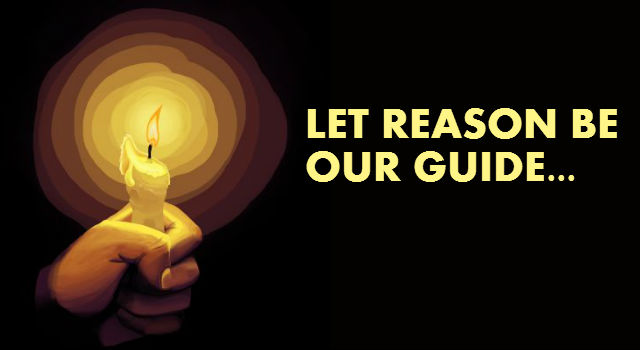
The original Light of Reason logo created back in 2014

Why I Am Not A Christian Anymore

I grew up in Southern California in the 1990s through the early 2000s with my older sister and younger brother. My parents were divorced and we lived with my mother but my dad was still around most of the time. From as far back as I can remember my father was always very religious (he would deny that term though, claiming that he doesn’t have a religion but “a relationship with Jesus”). This was always a common claim in evangelical fundamentalist Christian circles (even though the Bible itself says that Christianity is a religion: James chapter 1:26-27). Since mom was working so much (in order to pay the bills), dad would pick us up from school almost every day, take us to soccer or baseball practice, take us to get dinner or make dinner at home sometimes, and of course, he always forced us to go to church on Sunday mornings, even though we didn’t want to most of the time. When I was 10 years old we attended a Presbyterian church called Cathedral of the Valley, in Escondido California (it’s a different church now). It was a typical experience in terms of Protestant church services. It started with praise music, then a sermon from the pastor, the youngsters would get let go to Sunday School, then a longer sermon by the pastor, us kids would come back to the main hall, then an “altar call” mixed with passing around the offering plate for “tithing”, and then more music and maybe some more preaching. It was at one of these services, during the altar call phase, that I “felt the impulse” and went to the front to accept Jesus as my personal Lord and Savior, led by a prayer from the pastor. Right after this I didn’t feel much different but as time went on I started to interpret the world in a different way. I started seeing the world in terms of good versus evil, black versus white, and a spiritual warfare going on all around me.

As I entered high school I became very interested in playing drums and percussion. Years before, a friend from school had gotten me into them. He and his dad played rock drums and had two drum sets. So I bought a used set and started practicing every day. During my junior and senior years, I played in a couple of different punk rock and heavy metal bands and one of my bands was starting to get very serious. We had managed to get one of our songs on the local rock radio station and there was a lot of interest buzzing. However, it turned out that two of my band mates were Mormon and about one year into the band’s life, the two Mormons decided to go on their mission trip. This meant the band would break up and of course it upset me since we had worked so hard writing the songs and had major record label interest. As this played itself out I began researching Mormonism. I thought if I could somehow talk some sense into the guys, and convince them they are wrong about their religion, perhaps the band could continue toward our dream. At the advice of my father, I began gathering, reading, and studying Christian apologetics literature. This included books like: Kingdom of the Cults by Walter Martin, Evidence that Demands a Verdict by Josh McDowell, The Case for Christ by Lee Strobel, The Encyclopedia of Christian Apologetics by Norman Geisler, and many online resources. I studied intently for weeks and one evening, during a time when I had been feeling under the weather, and was attempting to go to bed early, I experienced a vivid and lucid dream (I interpreted it as a vision). My eyes were closed but I felt half awake in a sort of daydream-like state. In the dream, I saw Jesus come through the door of my bedroom, just in front of me. He had his hands open and at his sides. He was wearing an all-white robe-type garment, surrounded by a near-blinding white light. He had a white beard and long wavy white hair. I could not see his face but I heard him say to me (in my head, not an audible sound) “Aaron, I want you to do something for me. I want you to read the Bible“. “Ok” I said, and that was it. He disappeared back into the door. Immediately after that I woke up in a staunch cold sweat and called my dad, informing him of what I believed had just happened and of the good news. Naturally, he was very happy for me and I began reading from the book of Genesis immediately.

Defend, Defend, Defend

Shortly after this occurrence, I became very interested in both the bible and Christian apologetics (meaning, defending the claims of Christianity against its critics). Because of my frustration with my Mormon bandmates, I began to debate with them about Mormonism and Christianity. However, that didn’t last very long as the band broke up shortly after and they left for their 2 year mission trips. I had failed in my endeavor to convert them. However, around that same time I started getting plugged into the local churches in my area, including the Lutheran Church, Presbyterian Church, and the non-denominational Calvary Chapel. I also became very interested in Christian theology and philosophy. I wanted to prove to myself that Mormonism, and the other “cults”, were not true, and that what I called “Biblical Christianity” was the only true religion. As a result, this led me to a newly found lifelong endeavor (or so I thought). I became very interested in defending the Christian faith against any skeptics, doubters, or those who I perceived were worshiping false idols. In addition to going to church, I studied and prayed vigorously almost every day. Sometimes I would study for 8-10 hours per day or more. By this time, the internet was just becoming popular and I was excited because it allowed me to debate with atheists, Ex Christians, Agnostics, Mormons, Jehovah’s Witnesses, Muslims, and many others. After all, according to my interpretation of the bible, this was spiritual warfare and I wanted to save souls! Simultaneously, I was attending church, as well as Bible studies, about 4 to 5 nights per week while researching everything I possibly could about the arguments for and against Christianity. This went on for multiple years and over time I wound up purchasing about $2,000 worth of theology and apologetics-related books from the Christian bookstore near my house, as well as from yard sales, used bookstores, thrift stores, and Amazon. I would take every opportunity I had to defend the faith. For the most part, this meant debating online but I also did door-knocking as well as some street evangelism. I even went on a mission trip to Salt Lake City Utah in 2001, during the Winter Olympics, so that I could pass out anti-Mormon literature, debate with Mormons, and do my best to prevent as many people as I could from becoming Mormon. I believed they were worshiping a false God and leading people to hell. 

As I kept progressing, I found myself always wanting to learn more about Christian theology, apologetics, philosophy, and evangelism while also “defending the faith” wherever I found people who disagreed with me. This included co-workers, intermediate family, close family members, and friends. I made it a point to bring it up at nearly every family function, dinner, or get-together. Yes, I was “that one Jesus freak” that everyone knew about. I made my beliefs abundantly clear ad nauseum, and I didn’t care about their feelings because I knew I had the truth and they were on their way to hell and needing salvation.

A Series of Challenges

During this period of perceived “spiritual warfare”, when I was debating online pretty heavily, I started to come across challenges to my beliefs that I had not expected or seen before. On some of the online Yahoo forums, as well as a website called EXChristian.net, some former believers challenged me to read Dan Barker’s book Losing Faith in Faith: From Preacher to Atheist. They also challenged me to read the four Gospels of the New Testament and compare the resurrection narratives to see if the stories lined up (of course I discovered that they don’t). Additionally, they recommended that I study evolution and learn the science from scientists, and vetted textbooks, instead of Christian apologetics books and people like Kent Hovind who were misrepresenting the science. These challenges caused me to go even deeper into my faith, and to seek out other Christian apologists who knew more than I did. I was certain there would always be a solid answer to any one of the skeptics’ challenges, and I just had to find them. I searched online and found lots of resources but one in particular stood out. I discovered CARM.org (Christian Apologetics & Research Ministry), run by Matt Slick who was just starting the website. Coincidentally, he lived about 10 miles from my house and we became friends. In fact, I saw him as a mentor. It was through Matt that I learned about Dr Greg Bahnsen and presuppositional apologetics (for those who don’t know, this is the idea that only the Christian worldview can account for things like the laws of logic, mathematics, inductive reasoning, and the uniformity of nature). Upon reading and listening to Bahnsen’s materials, reading articles at CARM.org, and talking to Matt over many months, I became convinced that this was the ultimate defense of Christianity, “because of the impossibility of the contrary“ as we often proclaimed. I also became convinced that reformed theology was the best theological position (this is also known as the doctrine of predestination – which is the idea that God has already predetermined everything to happen in advance, including those who will be saved and go to heaven and those who will go to hell, and that there is nothing anybody can do to change it). Suffice it to say, I was even more nested as a Christian than before. The previous challenges from skeptics did not deter me but they did cause me to want to seek truth even more and to continue reading, studying, and learning while doing evangelism and serving the Christian community. 

As the months and years passed, I kept playing drums in bands while doing apologetics work, attending weekly Bible studies, doing street evangelism, and volunteering at various churches. I even became a youth pastor and taught Christian apologetics for a time. One night at a recording session with my band, at the recording studio where my dad worked, I met someone who has now become a dear friend, but who challenged my beliefs in a very profound way. His name is Ted (aka – T.W.). Ted was my father’s boss and the head engineer at the recording studio. I later learned that he was previously a very strong Christian for many years but eventually left Christianity and was now an agnostic. This seemed unthinkable to me. I was very curious as to why he left. How could he possibly know God and walk away, I thought. How could he have “felt the spirit” and now no longer believe? So I began meeting with Ted regularly and having conversations about his thoughts, story, and progression. I was certain that he was mistaken somewhere and I wanted to find out where so that I could prove him wrong. But what happened was quite the opposite. Ted began to challenge the very fundamental assumptions that I had made about the Bible, as well as the reasons I came to believe Christianity in the first place. It turns out that he was challenging me in much the same way that others had challenged him in the years prior, and how he has challenged himself. We discussed many topics but one of them focused on the clear contradiction between the idea that God is loving, and the idea that God creates animals specifically for the purpose of predation and causing suffering in order to survive (predation means being a predator and killing to eat). For example, he would challenge me to think about the fangs of a snake. These sharp poison injectors appear to be specifically for the purpose of trapping and killing prey, but if God (i.e. – Yahweh) is all-loving and all-powerful; this makes no sense, since if that were the case he could easily create creatures in such a way that they would not require the causing of such immense pain and suffering. What kind of a loving being would create such creatures (especially one that is allegedly all-powerful and has all possible options at his disposal)? If love means anything at all clearly it does not mean this. In addition to this, what did predator animals eat before the fall of Adam & Eve, fruits and vegetables? How did that make any sense with the teeth they have? Ted also challenged me to read the Bible on my own, without the influence of pastors, ministers, evangelists, apologists, or anyone else. He requested that I buy a notebook and write down any questions, or anything that didn’t make sense, as I read through the Bible. I thought it was interesting that a non-believer was asking me to read the Bible! As I did this I quickly began discovering what I perceived to be big problems in the bible that I could not stop thinking about. Those passages stuck with me (for example the idea that the god Yahweh allegedly commanded the Israelites to slay the Amalekites, along with all of their women, children, and infants in 1 Samuel 15 while at the same time being “loving”), or the fact that Yahweh condones slavery in Exodus 31 (allegedly saying that Israelites could own other people as property forever, pass them down to their children, and beat them). These, and many other passages, started to form “cracks in the walls of my fortress“. Such a command is clearly not consistent with a loving being. Later on I would hear Christian apologists, and other friends of mine, attempting to rationalize away these passages by claiming that these things happened because of sin, or that God has a “morally sufficient reason” for allowing such things but that “we just don’t know the reasons right now”. These responses sounded reasonable at first but eventually became wholly unconvincing to me as I thought more about them. What loving reason could be given for commanding humans to slaughter infants when you have all possible options available at your fingertips to solve problems? Is there any action that couldn’t be rationalized away this way; just claim it’s from God and therefore it is by definition loving? More and more, these responses began to sound like a way to hand-wave away any contradictions in the Bible so that belief in Jesus, the Christian God, the bible, etc (or at the very least, their preferred theology) could be maintained. In other words, all I was starting to hear was motivated reasoning, even though deep down I really wanted them to be right. I was desperate to find a way to make the puzzle pieces fit. However, I was certain that if the tables were turned and my Christian friends were being asked to believe in the claims of another religion (such as those in Islam or Mormonism), using those same types of responses, they would not allow such mental gymnastics. In this way, I found a kind of intellectual hypocrisy going on. I wanted to believe too but not at the expense of intellectual honesty or the honest pursuit of truth. So this experience was very painful. 

During this time I still kept the faith though, believing that I would eventually find answers to these apparent contradictions, trusting that because I believed I had the witness of the Holy Spirit nothing could overturn my belief. I prayed everyday for answers, wisdom, and guidance, and continued to study my Bible while being part of church and Bible study groups (even though I was experiencing cognitive dissonance). Unfortunately, the answers I was looking for never arrived. Instead, the problems and contradictions kept stacking on top of each other (like a pile of ever growing dirty dishes in the sink). The philosophical arguments for God also began to weigh heavy on my mind and one by one I would discover that they fell apart upon rational examination. I would ask the advice and counsel of friends, pastors, other Christian apologists, and even radio hosts but none of their answers were convincing. They all seemed like rationalizations that wouldn’t be accepted under any other context or opposing religious claim (I later learned that this had been called The Outsider Test of Faith by John Loftus). Some of them would just quote the Bible at me (as if that would suffice), such as the passage in 1 Corinthians that Paul wrote about Christianity seeming like foolishness to “those who are perishing” (but essentially to believe it anyways). One friend even told me to just pray about it and stop studying or thinking! He was essentially asking me to “just have faith“ which I could not do (and neither could he, if he was being asked to believe another religion).

The Road Out Begins

I kept finding examples of these double standards, as well as logically fallacious reasoning, almost everywhere I looked. I studied presentations, debates, defenses, and rebuttals to the claims of the Bible, the Kalam Cosmological Argument, the Ontological Argument, the Moral Argument, the Argument from Contingency, the Argument from Design (also known as the Fine Tuning Argument), The Argument for the Reliability of the Bible, and many others. The more I was honest with myself the more I realized that none of these arguments were powerful enough for me to continue believing in Yahweh, the god of the Bible. It was at this stage that I entered into a phase of ongoing deep bouts of on and off depression. “If God (Yahweh) isn’t real, then life has no meaning!“ I would say to myself. “Why not just kill myself now?! There’s nothing to live for!” I felt an immense and overwhelming amount of sadness, anguish,  and existential dread. Sometimes the emotional and psychological pain was so great that all I could do was go to bed and pass out, crying myself to sleep. I would call out sick from work and take days off at a time, reading my Bible and desperately praying that God would demonstrate to me, in no uncertain terms, that he was real. He never arrived. 

However, who did show up was Ted, and just as before, Ted challenged me to challenge myself and my own underlying assumptions that appeared to be what was causing so much pain. Why should it matter that life have an “ultimate meaning”? How could I justify making the assumption that without God life has no meaning at all? Where is this coming from? Why do I believe that? Ted would ask, “Does it make the apples taste any less sweet? Does it make you love your friends or family any less? Does it make the music sound any better or worse?” What Ted was uncovering were the layers upon layers of assumptions and beliefs that I had merely taken for granted over the years. Like most religious people, I had accepted those claims uncritically because I was influenced to do so from an early age. I didn’t have good reasons. Instead, I had faith, and faith is not a reliable way of knowing anything (I later discovered). 

It was at this point that I really started to turn a critical eye toward all of the previous beliefs that I had about the Bible, Christianity, and philosophy, though I really didn’t want to, since Christianity had become my identity by this point. I was no longer trying to “defend” or do apologetics. Instead, I was merely trying to see whether my theological beliefs held up to scrutiny. Instead of searching through and reading nearly all apologetics websites, trusting them to properly represent the other side, I began visiting websites like infidels.org, talkorigins.org, The Panda’s Thumb, ffrf.org, and others. I also began watching debates on YouTube between popular Christian apologists and atheists. One debate in particular has always stood out to me. In 2004, on the Atheist Experience show (on YouTube), Matt Dillahunty debated Matt Slick on the Transcendental Argument for God’s Existence (TAG). At the time I felt this was the strongest argument for God’s existence. During the debate, Dillahunty pointed out how Slick was “confusing the map for the place“. Essentially, he was confusing logic with the logical absolutes (the reality upon which the language of logic is based). “In a universe where there are no minds, a rock is still a rock and it is not not a rock.” Dillahunty said. Slick essentially attempted to deny this by claiming that in a universe with no minds there would be no truth. This is because he wanted to maintain that “Truth is a statement”, that it must exist in a mind, and that logic, (the language that humans have invented to describe a part of reality that we experience – similar to the language of mathematics), is the same thing as the reality we are describing, when in fact, as Dillahunty points out, they are not the same thing. Put more simply, a map is not the same thing as the place the map is referring to, and a photo of an apple is not the same thing as an apple. The reason why this point was important was because, using the TAG argument, Slick was claiming that the only worldview that could account for the laws of logic (i.e. – reality) is Christianity since, according to him, the laws of logic must reside in a mind. In other words, Slick was claiming that both logic, and the logical absolutes could only exist, be reliable, and be uniform if they exist in a universal mind. Dillahunty, on the other hand, was rebutting this claim by showing how a mind was not necessary for a proposition to be true. All that was necessary was that a certain set of conditions hold, which is the case in a universe where there are no minds to perceive it.

I couldn’t deny it. Quietly in the depths of my consciousness, I had to admit that Slick had lost the debate. A universal mind is not required in order for certain propositions to be true (that is to say, be accurate about the world). Therefore, the TAG argument failed. But from that point, I did not yet become an atheist. I was still a theist but I was now very skeptical of pretty much every argument that Christian apologists made for Christianity as I had known it (that is to say, the fundamentalist kind). Before then, I had never looked at the defensive arguments for Christianity very critically (Cosmological, Ontological, Teleological, Moral, etc) but now I was determined to do just that. At the same time, I was very curious, and much more open, to hearing the stories, and reasons, why other ex-Christian atheists left Christianity. This led me down a very long pathway out of the dark “dungeon of despair”, as I call it. But, I had to go deeper into the dungeon first. 

Into The Dungeon

In addition to reading and listening to defenses and arguments for the existence of God, I began looking a lot more closely at the other side. I read and listened to people like Dan Barker, Scot Clifton (aka TheoreticalBullshit on YouTube), Bart Ehrman, Sam Harris, Christopher Hitchens, Richard Carrier, John Loftus, Sean Carroll, Tracy Harris, and of course Matt Dillahunty. For the most part I listened to them through live or pre-recorded debates, but other times they were responding to claims and arguments from apologists. In either case, every argument that I had previously thought was a solid argument for Christianity, the alleged divine inspiration of the bible, or the existence of Yahweh, was exposed as being logically flawed in one way or another, or just a mere assertion (such as in the case of presuppositional apologetics). One interesting thing to mention here too is that, in all of my years of reading and debating these arguments I have never once come across a theist who became a theist because of one of these arguments. In my experience, it is usually always the case that they came to believe first and then went about using these arguments as a protection mechanism. Here is a short list of some of the major arguments I could no longer accept as sound. 

  • Transcendental Argument 
  • Argument for Divine Origin of the Bible
  • Argument from Historicity
  • Kalam Cosmological Argument  
  • Teleological Argument
  • Ontological Argument 
  • Moral Argument 
  • Argument from Miracles
  • Argument from Personal Experience 
  • Argument from Contingency 
  • Argument from Consciousness 
  • Argument from Sensus Divinitatis
  • Evolutionary Argument Against Naturalism
  • Fine Tuning Argument

This is not an exhaustive list, and I won’t detail here why I do not accept these arguments anymore (I will do that in future posts). However, suffice it to say for now I eventually arrived at the bottom of the dungeon and found no fire-breathing dragon in sight. I not only came to the realization that none of these arguments were sufficient for me to continue believing in Christianity (they all suffer from one or more logical flaws) but also that no argument, by itself, would cut it. In other words, I realized within myself that I will not accept religious claims via the avenue of argument alone. And even though I had previously believed that I had an experience with Jesus in my bedroom years prior, through careful reassessment and critical thinking I came to the realization that it was not rational to draw that conclusion. How could it be? Since human beings make mistakes in reasoning all the time, and a more parsimonious explanation existed (i.e. – that it was a dream and I was mistaken in my interpretation) it is far more likely that what I experienced was just a creation of mind (just like other cultures experience in a similar fashion as well). Given these things, I had no choice but to let go of Christianity and Christian belief. After all, you don’t choose your beliefs. You become convinced by good evidence, bad evidence, or a combination of the two.

By late 2007, I had an opportunity to move to Arizona with a friend to start a music lesson business, and I decided to take it. Just before leaving town I had dinner with some old friends from church. I gave them the news that I was no longer a Christian and they were extremely surprised. One of them said, “No… You just forgot! You will remember! You just forgot!”. They knew how strong of a Christian believer and defender I was before, but I thought this was a very strange response. Unfortunately for her, my friend was quite mistaken. I moved to Arizona and didn’t think twice about ever going back to Christianity. For me, this would be like attempting to force myself to believe (not just say that I believe, but actually believe) that there is a winged rainbow-colored unicorn flying right next to me right now. I can’t do it, and this is exactly how I felt about Christianity. I could not force myself to honestly believe something for which I had no sufficient evidence to believe. And even though I was still suffering from a good amount of depression, since I was still feeling some of the effects of what I call “residual Christianity“, there was no going back. From that point forward, I considered myself a deist (for the time being). 

From Deist to Atheist

In Arizona, I didn’t do much reading, researching, or studying philosophy or theology. I decided I was going to focus almost solely on my business and getting fit through dieting and exercise at the gym. I did these two things consistently for about 2 years but as the housing crash of 2008-09 came upon the world my business gradually dwindled and eventually I was forced to move back to California. I went back to teaching drum lessons privately and decided I would also enroll in school to get my bachelor’s degree in philosophy. Since I loved teaching, and I was very interested in studying philosophy, I figured I would work toward becoming a college professor. From 2009 to 2011, I focused diligently on work and school. I was determined to make my life better but at the same time my interest for philosophy had been rekindled and was growing by leaps and bounds. I took courses on the philosophy of mind, the philosophy of science, the philosophy of language, aesthetics, ethics & moral theory, metaphysics, and many others. While working on my studies I developed an immense passion for all things philosophy. Any extra time I had, I spent reading and studying various philosophical arguments and positions, especially arguments for and against the existence of God (whatever that term means). I was still determined to find a sound argument for the existence of some kind of deity. In fact, any paper I wrote in college pertaining to the existence of God, was always on the pro side. However, I wanted to take as objective an approach as I could. So I always researched the rebuttals and responses to the arguments I was making and the beliefs that I had. I still felt very much attached to the idea that there must be a God of some kind out there, someone that started everything off. Yet, just as before, I would eventually discover that my arguments contained logically fallacious reasoning and were not sound. To my sadness at the time, I eventually came to a point where I had to admit that I did not have any sound arguments for the existence of a God or the supernatural. At this point I was once again thrown into a deep depression. “What is life’s meaning? What is the purpose of everything? If there is no God then everything is chaos! How can I know what is right or wrong? There’s no foundation! We are in big trouble! We are all alone and life is very scary! The world has become a jungle of psychopathic indifference with no real justice! I’m just an animal like every other animal, living to eat, shit, and then die!” I thought. And once again, my friend Ted was there to challenge these assumptions. “Why does life have to have an ultimate meaning? Why is that required? Where did you get the notion that everything is chaos? How is that justified? What do you mean by “no foundation”? Foundation for what? Why is life so scary? What is scary about it? What is justice? What does that mean?” These questions got me to challenge my own underlying assumptions about the nature of reality. I started to see things in a completely different way, a way that I had not seen before. I saw a different pathway, a different description of life and my surroundings. If there was ever such a thing as a personal enlightenment, this was it for me. I started to realize that there was a completely different way to look at reality and the world, a reality without assuming the supernatural.

By the time I graduated college it eventually dawned on me that I didn’t have any good reasons for believing in a god of any kind. Up to that point, I was still convinced that presuppositionalism was the way to go, and that some kind of deist-type God was the necessary precondition for intelligibility and the uniformity of nature. Essentially I believed that a deistic God solved Hume’s problem of induction (which is the notion that there is no way to show any logically necessary connection between past cases or events and future cases or events). But eventually, that argument, along with all the other arguments that I had heard, did not stand up to rational scrutiny. I went back and listened to the Dillahunty/Slick debate again. It became so clear. Arguments in and of themselves are not sufficient for me to believe in the supernatural, of any kind. I remember thinking about Carl Sagan’s famous quote, “Extraordinary claims require extraordinary evidence” and at that point I had not even seen or heard ordinary evidence for a god, let alone extraordinary evidence. Adding to this, I remember listening to an episode of “The Infidel Guy” on YouTube (the channel is no longer in operation). Reginald Finley (The Infidel Guy) was interviewing Matt Slick when a caller called in asking Matt to “define his God”. What stuck with me was that Matt was unable to define God with any positive primary characteristics. He was only able to provide either negative adjectives (“not material”, “not physical”, etc), essentially telling us what God is not, or point to secondary characteristics such as: all powerful, all-knowing, all-good etc. Not only was this wholly unsatisfying to me but it also got me thinking. Perhaps the notion of God is itself meaningless, or at the very least irrational (it turns out this position is called Theological Noncognitivism). How can something exist and have no essential characteristics that can be named? What is the substance of a “spirit”? I searched for answers, and as with so many other times before, I came up short. Everything always came back to alleged negative characteristics, which were not an answer to my question. If God is a spirit, and a spirit is something that is real, then what is it made of? What is its composition? What primary attributes does it have? I could find no answers that made any sense, and since knowing the truth was far more important to me than holding onto a belief, I had to give up the belief. 

In the end, I am not a Christian anymore because I discovered that the reasons I had for believing in God were not good reasons and that the reasons I heard other people give for believing in God were also either logically fallacious or based on mere assertions. It was almost as if at some point along the line a properly skeptical switch had been slowly flipped on in my mind and I could not turn it off. Anytime I heard or saw an argument for the alleged supernatural, miraculous, God, Christianity, or any other religion, I would instantly begin to see the flaws. I am happy to say that this critical thinking “skeptical skill” still resides within me today and it is my intention, and hope, to spread that skill to as many people that I can while I am on planet Earth.

I will end with one of my favorite quotes of all time, from the late great Christopher Hitchens:

“Take the risk of thinking for yourself, much more happiness, truth, beauty, and wisdom will come to you that way.“  

Christopher hitchens  

Rebuttals & Responses

  • You were never really a true Christian!

This sounds like the No True Scotsman fallacy (which is logically fallacious reasoning). Can a Muslim be a “true Muslim” while Islam is at the same time false? In other words, can someone be a true believer of a particular religion even though that religion is false? If so, then you admit that a religious belief being “true” is not required for someone to be a true believer. This would mean that you, and Paul in the bible, are wrong. The only real criteria for someone to be a true Christian is whether or not they honestly believed it to be true, and I did.

  • You must not have known the arguments well enough.

I knew the arguments quite well and they were not convincing, and still are not convincing. Not only that but each of those arguments (cosmological, teleological, ontological, moral, transcendental, etc) not only contain logically fallacious reasoning and thus I cannot accept them as sound, but they are also insufficient for me. No argument on its own is going to convince me that an alleged “god” (whatever that means) exists, especially if this alleged being interacts with the world in any detectable way. Would an argument, by itself, be enough to convince you that I have a pet fire-breathing dragon?

  • God is obvious. You’re just blinded by sin and suppressing the truth in unrighteousness! 

Parotting Romans chapter 1 is not going to be persuasive but you knew that already, right? This is no better than just saying “For the bible tells me so!”. How is that supposed to be convincing to anyone except those who already assume your beliefs are true? Would this line of argument be convincing if a Muslim used it against an ex-Muslim? Should it be? “It says so right here in the Koran! Therefore, it’s true!” That doesn’t work, does it? Therefore, it doesn’t work when you use it. Second, how is god “obvious”? The trees? Life? The universe? These things do not merely explain themselves. They indeed may require some sort of explanation, but merely asserting that your explanation is the correct one (because you say so or because you think the bible says so) is also not convincing. Would you be convinced if I claimed that those things are obviously explained by the flying spaghetti monster, or if another religion (which is opposed to yours) made a similar claim? All you are doing here is merely asserting & assuming that your belief is true, from the outset, and I see no good reason for making that assumption. Also, I think you don’t either, if you are honest with yourself. Assuming your position is true, doesn’t make it true and the time to believe a claim is after sufficient evidence has been brought forth, and not before.

  • So now you believe we came from nothing? 

Nope. I do not accept the claim that there ever was such a thing as “nothing” or “ex-nihilo” or “non-existence”. These also are just assertions. I see no good reason for believing there ever was a “non-existence”. This idea also sounds nonsensical. If “nothing” existed then wouldn’t it be something? In fact, I have to assume that you also do not believe there ever was a “nothing”. If you are a deist, theist, or pantheist, do you believe god is “nothing”? If the alleged thing you are calling god is “something”, and it always existed, then there never was “nothing”, was there? Thus, it seems to be the case that there always was, in the very least, something.

  • You must have had some sin in your life that allowed Satan to creep in. 

This once again assumes your belief in the Bible, or the Koran, which of course I do not accept, but it’s not relevant. All Christians, and Muslims, whether they admit it or not, have “sin in their life”. When you started believing in Jesus or Mohammed did you stop “sinning”? If not, then you have “sin in your life” too. Second, this response also just looks like you are assuming your interpretation of the bible is true, but why should I do that? How does it make any sense at all to assume your religious beliefs are true from the outset, instead of being skeptical first and then doing a proper investigation?

  • Without God life has no meaning. You should have known that. 


Why does life have to have an absolute or “meaning” on the cosmic scale? How can you justify this belief or requirement? I see no reason for thinking that life must have “infinite meaning” in order for it to have meaning in general, or even multiple meanings. Also, what is “meaning”? How are you defining that term? I suspect that we are thinking about that word, and its relevance, in two very different ways.

  • You’re going to hell!

This is just Bible-thumping. “For the bible tells me so” is not going to cut it. At that point your assertion is no better than any other religious claim from any other religion. Why should I accept such a claim?

  • Where do you get your morals from then? 

I get my morals from a rational consideration of the consequences of my actions. However, whenever this question comes up, what I almost always suspect is that we are likely operating from different definitions of the term “morality”. If your definition of “moral” means something like “that which aligns with the nature of God” etc, then I don’t care. I see no reason for thinking that your alleged god is real, nor do I find that definition useful or helpful. In fact, it has shown itself to be quite harmful throughout history. At that point, you might as well just throw out your moral intuitions and just do whatever you believe an alleged god tells you to do, even if it does immense harm to tons of people. I wholly reject this approach. Remember the story of Jephthah in Judges 11, when he allegedly slaughtered his daughter after Yahweh allegedly allowed him to win that war? Yeah, I reject divine command theory altogether. All it looks to be is an a-moral (non-moral) blank check for doing whatever you actually wanted to do in the first place, so that you can feel justified in doing it. That’s not morality as far as I’m concerned. As Tracy Harris once said, that’s just a dog doing what its owner told it to do. It has nothing to do with morality.

Instead, I think morality (in general) pertains to the demonstrable well-being of conscious creatures and society, and it does not matter to me that there is no perfect definition (much the same as it does not matter to me that there is no perfect definition of the term “health”). As far as I can tell, there is no such thing as a “perfect definition” of nearly any term, and yet we don’t need such a thing to move forward with life and do the best we can to improve people’s lives to the greatest amount and degree possible.

  • Science can’t explain the origin of the universe, therefore it must have come from a god! 

This is the classic and infamous, Argument from Personal Incredulity fallacy. It is logically fallacious reasoning. It is, effectively, a god of the gaps argument. Just because science has not yet explained something today does not mean or imply that it will not be able to explain it in the future, nor does it justify a claim to the supernatural or miraculous. Superstitious people in history have also attempted to use this same type of argument to explain things like sickness or disease, lightning, thunder, the shape of the earth, and many other unexplained phenomena. This argument didn’t work then, and it doesn’t work now because the time to believe a claim is after we have sufficient evidence, not because we can’t imagine another explanation. Instead, the better answer is to say “I don’t know“, but unfortunately we live in a world where many people are uncomfortable admitting when they don’t know something. It is my hope to change that thinking as much as possible within society. Just because we don’t know something about reality doesn’t mean we can’t live relatively happy, healthy, productive human lives.

Aaron Lietz
Founder & President
Light of Reason Foundation

Logic Test II

This is the second logic test in our series. All human beings make mistakes in reasoning. Our hope is that these tests will help you improve your knowledge of logical fallacies so that you can spot them in both yourself and others while improving your ability to apply correct reasoning in everyday life.

Logic Test II

Definitions

• Genetic Fallacy – Basing the truth claim of an argument, or proposition, on the origin of its claims or premises. 
• Begging the Question – Any form of argument where the conclusion of the argument is assumed in one of the premises of the argument.
• Cherry Picking – When only select evidence is presented in order to persuade the audience to accept a position, and evidence that would go against the position is withheld.
• Hasty Generalization – Drawing a conclusion based on a small sample size, rather than looking at statistics that are much more in line with the typical or average situation.
• Fallacy of Composition – Inferring that something is true of the whole from the fact that it is true of some part of the whole.
• Fallacy of Division – Inferring that something is true of one or more of the parts from the fact that it is true of the whole.
• Appeal to Emotion – Using emotional appeals instead of reason in an attempt to win an argument.
• Equivocation –  Using a term in an ambiguous way, or in more than one sense, making an argument misleading.
Complex Question – A question with a built in presupposition which is not explicit (loaded question).
• No True Scotsman – Defending an assertion by disallowing, by definition, all counterexamples, emphasizing that we are only talking about true examples of whatever population is under consideration.

Reference:

https://www.logicallyfallacious.com/logicalfallacies/search

https://www.palomar.edu/users/bthompson/Table%20of%20Fallacies.html

https://yourlogicalfallacyis.com

Logic Test I

Are You Logical?

Think about the last time you found out that you had been believing something (regardless of how important or unimportant) that turned out to be false. Now think about how firmly you held that belief. On a scale of 1-10, how strong was the belief? Finally, what were the reasons you held that belief? Did it turn out later than some of those reasons were bad reasons? Thinking along these lines can help clarify where things can go wrong when forming beliefs. One of those causes is irrational thinking (i.e. – illogical reasoning).

Human beings are naturally prone to making mistakes. This includes mistakes, both large and small, in the areas of cognition and rationality (i.e. “thinking and reasoning”). Logically fallacious reasoning and cognitive biases are extremely common but with a little effort we can push back against them and “get better at thinking”. Below you will find the first of a serious of multiple choice logical “quizzes” I have created in order to assist the world toward that end. If these exercises help you, I am happier that much more!

Logic Test I

Definitions

  • Ad Hominem (Abusive) – Attacking a person who is making the argument rather than the argument itself, when the attack on the person is totally irrelevant to the argument.
  • Post Hoc Fallacy – Claiming that because event Y came after event X, event Y must have been caused by event X. This fallacy is also called Post Hoc Ergo Proper Hoc (after this, therefore because of this).
  • Straw Man – Misrepresenting a person’s argument and then attacking that misrepresented version of the argument, instead of the actual argument that was made.
  • Red Herring – Attempting to direct the topic of the argument to a different issue or topic.
  • Ad Verecundium (Argument from False Authority) – When a person making a claim appeals to a person who is being presented as an expert when in fact said person is not an expert in the relevant field that is being debated.
  • Argument from Ignorance – Assuming an argument is true based merely upon the perception that it has not been proven false or due to the perceived lack of evidence to the contrary.
  • Argument from Personal Incredulity – Arguing that because you can’t or refuse to believe something, it must not be true, must be improbable, or the argument must be flawed.
  • Begging The Question – A form of circular reasoning where the conclusion of the argument is assumed in one of the premises.
  • False Dichotomy (False Dilemma) – When only two or more choices are presented yet more choices exist, or where a spectrum of choices exist between two extremes.
  • Special Pleading – Applying standards or principles to a person, people, or set of circumstances while making oneself, or a specific set of circumstances, exempt from said critical standard, without proper or critical justification.
  • Ad Baculum (Appeal to Force) – When force, coercion, or a threat of force is used in place of a reason to justify a given conclusion.
  • Genetic Fallacy – Basing the truth claim of an argument on the origin of it’s claims or premises.

Reference:

https://www.logicallyfallacious.com/logicalfallacies/search

https://www.palomar.edu/users/bthompson/Table%20of%20Fallacies.html

https://yourlogicalfallacyis.com